On Twitter…

About a month ago, I joined Twitter.

My account: http://twitter.com/arnoldkim

I’d heard all the commotion about it for some time, but finally decided to join in on the fun. I’m still a relatively sporadic poster of Twitters, but find the conversation interesting and distracting. I think for all the hype about twitter, the descriptions of it never really “sold” it very well.

For my part, the best way to describe is group instant messaging. For the old-timers, it most feels like sitting in an IRC channel all day long.

If you have any interest in topics I post about in this blog, feel free to follow me on Twitter.

Posted in Business | 1 Comment

Application Icons and Domain Names

Years ago, Apple published a developer magazine. I don’t even remember the name of it, but it covered various topics on programming on the Mac or Apple II, but it would also occasionally have humor articles. One in particular stuck with me.

The author said that when you are getting ready to start developing your application, the single most important thing to do is you need to develop a killer icon. The desktop icon could make or break your application and it really should be your first priority.

As humorous a suggestion as it was, I think what I found most amusing was that there was a slight bit of truth to it… or at least it didn’t come from that ridiculous a place in the mind of the developer.

I’ve long thought the web-developer equivalent to that is the domain name. Like most web-folk, I have a lot of ideas for websites on a regular basis. Some are just passing thoughts, others, I might sit down and consider developing at some point in the future. Once I feel serious enough about an idea, my first priority is to find the perfect domain name. Without the perfect domain name, it’s very hard to make any further progress on the idea.

Like the icon, it’s the centerpiece of the idea, and can make or break the entire project. I don’t believe everyone necessarily thinks like this, though. I’ve heard stories of people just picking a domain and planning on changing it later, or maybe even growing into it… but that sounds crazy. The domain is the brand, and if I don’t feel like it represents the site or idea perfectly (or as perfectly as I can afford), then I have a hard time proceeding.

Anyhow, it’s this line of thinking and my unnatural love of domains that has caused me to become a domain name hoarder, with numerous names in my portfolio waiting to be developed.

Posted in Domains | 6 Comments

Compete.com’s Margin of Error

When we try to figure out the growth of a site, or the relative traffic between sites, we often turn to the only free public tools available for the job.

That would be Compete.com and Alexa.com. Both are known to be inaccurate, however, Alexa perhaps more notoriously so.

The reason for their inaccuracy is the method of their tracking. Alexa relies on traffic stats from their toolbar that users must install. So, it’s not a representative cross section of the internet. Compete incorporates data from ISPs, toolbar users, and opt-in panels. Despite their added efforts, I’ve found their numbers to also be way off.

Finally, there’s Quantcast — another traffic estimator service. I’ve personally found their estimates to be equally inaccurate. However, unique to their service is the ability for site owners to place actual Quantcast tracking tags on their site so their traffic is directly measured. Once they collect enough data, they will display (if you chose to opt in) the actual traffic stats for all to see.

What this means is we can actually compare actual traffic stats to Compete’s estimated traffic stats (which are also reported in uniques/month) to see what Compete’s margin of error can be across different sites.

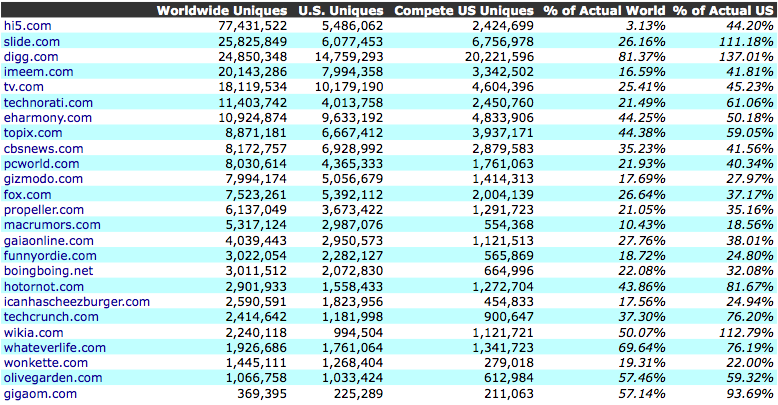
Based on a small sample of websites (n=25), Compete’s estimates predict from 18.6% to 137% of a site’s actually measured traffic stats.

See this graph (click for larger):

traffic.jpg

Explanation of Columns

Worldwide Uniques
  Actually measured Worldwide traffic via Quantcast

U.S. Uniques
  Actually measured U.S. traffic via Quantcast

Compete U.S. Uniques
  Compete’s estimate based on their aggregate data.

% of Actual world
  How far off is Compete’s U.S. numbers compared to Actual Worldwide

% of Actual US
  How far off is Compete’s U.S. numbers compared to Actual U.S.

Now, to be fair, Compete only claims to offer estimates of U.S. monthly uniques, but I’ve included Worldwide uniques to point out how deceptive this can be for sites with a large international audience, such as Hi5.com. Compete’s U.S. estimate only counts 3.13% of Hi5’s actual worldwide traffic. Even when comparing U.S. numbers, Compete still underestimates Hi5’s U.S. traffic by over 50%.

Worst Estimates (U.S.)

In our small sample size, the most underestimated traffic sites where

MacRumors.com – 18% of Actual U.S traffic
Wonkette.com – 22% of Actual U.S. traffic
FunnyorDie.com – 24.8% of Actual U.S. traffic
icanhascheezburger.com – 24.94% of Actual U.S. traffic
Gizmodo.com – 27.97% of Actual U.S. traffic
BoingBoing.net – 32.08% of Actual U.S. traffic
Propeller.com -35.16% of Actual U.S. traffic

Best Estimates (U.S.)

These sites’ estimates were not that far off, and in some cases overestimated actual numbers.

Whateverlife.com – 76.2% of Actual U.S. traffic
TechCrunch.com – 76.2% of Actual U.S. traffic
Hotornot.com – 81.67% of Actual U.S. traffic
Gigaom.com – 93.70% of Actual U.S. traffic
Slide.com – 111.18% of Actual U.S. traffic
Wikia.com – 112.79% of Actual U.S. traffic
Digg.com – 137.01% of Actual U.S. traffic

Conclusions

I’m not sure if many conclusions can be drawn from this data alone, but it just shows that traffic stats estimates can be very deceptive. I was somewhat surprised that some sites’ estimates were actually greater than their actual stats.
Posted in Business | 8 Comments

Traffic Stats of Top Blogs

A pet peeve of mine is when bloggers mistakingly interpret Technorati’s Top Blogs list as a measure of a site’s relative traffic.

This is not what it measures.

Technorati’s Top Blogs list measures the number of inbound links, not traffic — though there may be a loose correlation.

As a side effect of this list, TechCrunch, which is near the top of this list, is frequently cited as one of the most popular blogs on the internet. I have nothing against TechCrunch, and certainly agree it’s amongst the most influential blogs, but in terms of pure traffic, it’s very respectable, but not at the top of the list.

The problem in determining relative traffic amongst blogs is that relatively few sites publicly broadcast their traffic stats. Instead, we’ve had to rely on expensive ComScore stats (not very accurate), or public trackers, such as Alexa and Compete — also notoriously inaccurate.

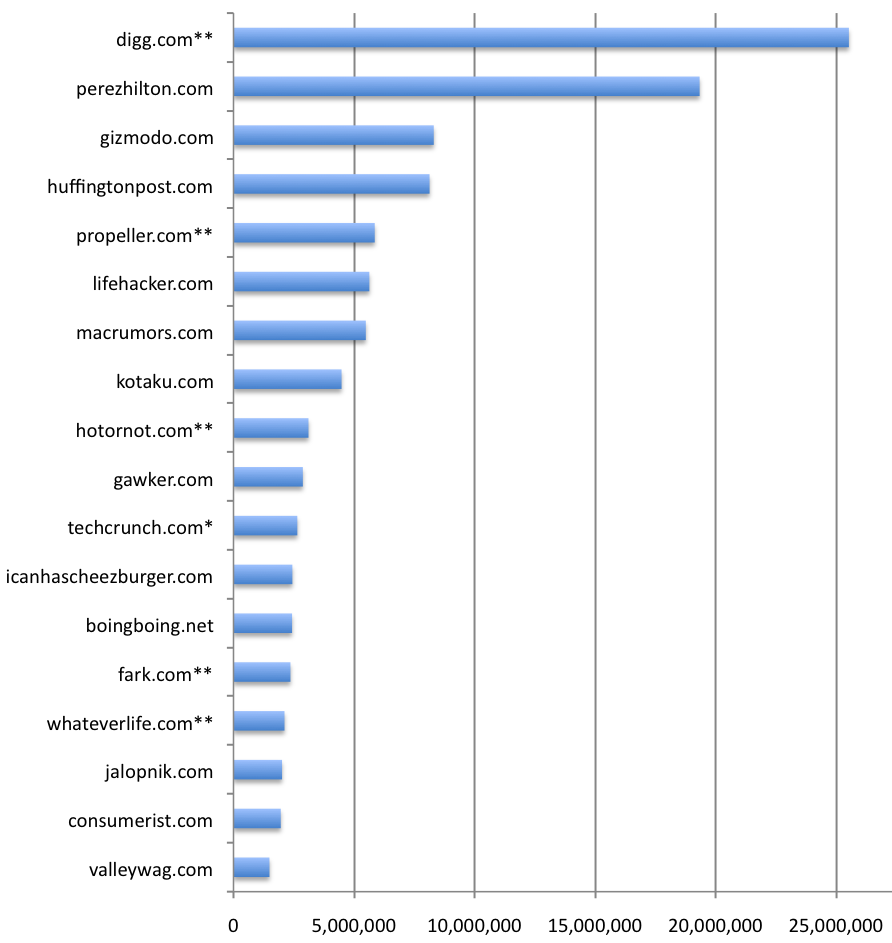
So, I’ve compiled a list of well known blogs that have public measured (not estimated) traffic information (via Quantcast) and added in TechCrunch’s self reported numbers as well. I’ve also included a few non-blogs as points of reference. These include: digg.com, propeller.com, whateverlife.com and hotornot.com.

uniqtraf.png
x-axis: monthly uniques

This is not an exhaustive list. Only sites that publicly report their numbers are shown. Most blogs keep their traffic figures private.

* TechCrunch stats are from January 2008, reported in their blog.
** these are not blogs, but included for reference.

Some interesting notes about some of the sites on the list.

WhateverLife.comstarted by a 14 year old. Now an emancipated 17 year old. Turned down a $1.5 million offer for the site, and appears to be doing quite well.

HotorNot.comacquired for a rumored $20 million. Was reportedly making millions a year through their dating service.

Icanhascheezburger.com – a LOL cats site started by Eric Nakagawa in January 2007 who now works full time at his site.

Overall, an interesting perspective. I think we tech web folk get caught up in our own little worlds, and should realize that a site like PerezHilton attracts over twice the number of unique visitors in a month than the very popular Gizmodo.

Posted in Business | 7 Comments

Digitimes… Now An Accurate Source of Apple Information

Last year, I wrote an article about how Digitime’s accuracy with relation to Apple-related rumors had been very poor. It based on their historic results at the time. Things have changed considerably, however, and I try to give credit where credit is due.

Over the past year, Digitime’s accuracy has been remarkably good with respect to Apple related rumors, and I now pay close attention to their reports. All the following reports turned out to be true:

Leopard Delayed
LED Apple Notebooks
Wifi/Flash iPod
13.3″ Screens for upcoming Apple Laptop (ended up being the Air)
September iPods

So, good job Digitimes…

Posted in Mac Web, MacRumors.com | Comments Off on Digitimes… Now An Accurate Source of Apple Information

I Wish Articles Would Make Sense

As MacRumors editor, I read a lot of random articles…. and one of the most frustrating things is finding what sounds like a good relevant article… which at first glance seems fine, in the end, doesn’t quite make sense.

Here’s one I found yesterday:

Why Apple’s secretive approach is so effective – some researchers studied the effects of pre-announcing and not pre-announcing products and how that affected consumer spending.

It’s this pre-release hype makes people much more careful about what they buy. If you tell them that something is coming at some point in the future, they will evaluate everything that’s out there very carefully. But if you just drop something into their laps, all they’ll think about is the brand. And if they like that, ker-ching!

To sum up:

Pre-release announcement = more cautious buying habits
Immediate release = impulse buying

The article presumes that Apple takes advantage of this psychological tendency. The problem lies in the exact definition of “immediate release”. The research article isn’t published yet, so we have to rely on a press release.

If you define “immediate release” as actually available in stores (to see and touch), then Apple’s brand new products rarely fall in this category. Apple TV, Apple TV 2.0, iPhone, MacBook Air all had week to month lead times before they were available. The iPhone, itself, was 6 months from release, and no pre-orders were possible.

So how does this help prove the author’s point? I don’t think it does at all.

Now if you redefine “immediate release” to “can preorder immediately”, then an argument can be made for the MacBook Air. Apple announced the Air, and you could impulsively buy it, without doing research. Ok sure…

But what about Apple TV? The original one (codenamed iTV) was pre-announced months in advance, even before it adopted the “Apple TV” name. So, this would argue that Apple suffered (not benefited) from this pre-announce strategy.

What about the iPhone? Apple pre-announced the iPhone on January 9, 2007. No pre-orders were available and it wasn’t available until June 2007.

It was a nice theory, with some actual research to back it up, but in the end Apple’s “secretive approach” seems to have no correlation with this research.

Posted in Mac Web, MacRumors.com | 8 Comments

Understanding Sites. Hurdle to adoption?

Besides my usual website activities, I tend to pay a lot of attention to the nature of the websites, and like to explore what’s been popular and what’s not. For personal interest as well as research for potential new projects.

In particular, I’ve had an interest in news sites in particular. Be it, full articles, or just headline/link aggregators. I tend to look at a lot of sites and have a my own opinions on whether a site “works” or not.

I think for the geekly oriented, Slashdot probably represented one of the first regular news site that many of us visited with any regularity on the internet. It’s no secret that MacRumors was modeled after Slashdot’s look and feel… and for good reason. Slashdot made sense. Stories posted in reverse chronological order with the “best” stories posted to the top and moved down sequentially. I suppose it didn’t have to happen that way… but that’s the popularized format (and I’m not necessarily saying Slashdot established it, but it was my first real exposure).

The problem is that there’s a lot of the new sites I’ve seen is that I feel don’t make sense. But it wasn’t until I read a blog post about the relaunch of a site called Topix.net that I’d ever seen it articulated.

In researching how their site “sucked”, they actually did focus groups on their site. And what did they learn? That their pages “didn’t conform to any standard web page metaphor”.

People don’t lean forward and squint at web pages to figure out how they work anymore. They instantly recognize — within 100 milliseconds — which class of site a page belong to — search result, retail browse, blog, newspaper, spam site, message board, etc. And if they don’t recognize what kind of page they’re on, they generally give up and hit the back button.

Now, this isn’t to say there isn’t room for innovation, and doesn’t explain the skyrocketing success for a site like MySpace, but it does make you reconsider when trying to launch or design a new site.

It also explains some frustration that I’ve run into when trying out the newest Web 2.0 sites that pop up every day. If the site doesn’t immediately make sense, I don’t generally spend too much time to try to figure it out. No matter how great your site really is, capturing the attention of your audience is your first hurdle.

Posted in Business | 2 Comments

MacRumors’ Macworld Coverage Success and Sleeping on the Sidewalk

This year, MacRumors’ coverage of the Macworld San Francisco 2008 keynote address knocked it out of the park. Reviews were universally positive, and it makes me really proud of what we’ve accomplished.

What makes this accomplishment even more impressive is that we’re a relatively rag-tag crew pulling it together against better funded sites with far better keynote access. No one at MacRumors is a full timer. At present, we’re still a combination of part-timers and volunteers.

In the end, I was unable to get a “keynote” media pass to Macworld. No big surprise — despite our size, MacRumors doesn’t get much recognition from Apple (or IDG). This, however, means that I had to buy my own ticket (Superpass) into the Keynote, and stand in line to get a good seat. Of course, the night before I became nervous about not getting a good enough seat… which means I ended up on the sidewalk at 1am (and I wasn’t first in the Superpass line) the night before trying to get some sleep. I got maybe an hour of sleep before people starting milling about, and I started getting uncomfortably cold. So, I ended up chatting and moving around (to keep warm) for the next 7 hours while I awaited keynote access.

In the end, it was me and Jeff Longo in the Keynote providing updates from mid-way-back seats. We had a volunteer crew at home handling the server side and processing data. But that was enough to provide the best keynote coverage on the web.

I like to think that due to our limited resources, we’ve had to work smarter and harder in order to keep up. We also aren’t restricted by the ever-important “page view” metric that tends to drive the more commercial sites’ coverage. We employed additional servers and multiple Content Delivery Network (CDN’s) to support keynote traffic, but due to our efficient setup, we are able to run it at a fraction of the cost.

I’m sure competition will increase, especially after our success this year, but we’ll continue to step up our features. This year, we added large (640×480) photos, and an iPhone/iPod touch formated site. There will be more to come.

Posted in MacRumors.com | 24 Comments

The Special Hell of Site Redesign

When you have an established site, one of the most tumultuous events that can happen is a major site redesign. No matter what the changes are, no matter what the improvements are, there is always a very vocal group of people who simply hate it.

Now, to be fair to those users, changing the look and feel of a site that they’ve grown accustomed to is certainly a disorienting experience.

Macworld is about to undergo a major site redesign and has already seen a bit of criticism based on the beta site. The other scary part of their move is a change in forum software from UBB.threads to Jive. I suspect the outcry from that move alone could drown out any criticisms of their site design. Hopefully, they’ve spent time to make the forums “feel” the same as it did under UBB.threads. Good luck!

The fear of a site-redesign has what kept MacRumors in its current form for the past 4 years. But lately I’ve decided that its time to look into a site redesign and we’re starting to look for the right designer to do it.

Posted in Mac Web | 2 Comments

Less is More, at least on MacRumors

MacRumors.com has developed a unique culture over the years, which is a product of its primary author (myself), I suppose.

MacRumors was never all about the rumors, but clearly, that’s been a big focus of the site. In the early days, rumors were shunned by the mainstream media. This was before blogs took off, and Apple rumors became regular CNBC content.

Instead, there used to be a couple of established rumor sites, and then there was the mainstream Mac web. And apple rumors would never be published on the mainstream Mac web. This all changed in the past few years, seemingly around the time that Apple sued ThinkSecret and subpoenaed several rumor sites. It’s hard to say whether this legitimization of rumor sites contributed to rumors jumping into the mainstream, or if it would have happened anyway.

Regardless, as blogs have become more mainstream, there’s a few gadget sites (Gizmodo and Engadget) which have grown an enormous audience. I’ve personally found the most curious part of their success is the sheer volume of updates. It’s not uncommon for them to have 50-100 posts in one day. Is their traffic simply a side-product of having so many pages for people to view? Or do people really want this much content? Even if some of it, is… well, less than interesting.

MacRumors has always been more of a quality over quantity site. Early on, this was easy, since Apple news and rumors tended to come a little slower than they do these days. This was also because I was never a full-time blogger, so by necessity, I couldn’t update as often.

Recently, I thought, would MacRumors benefit from much more frequent updates? In the end, the answer seems to be “no”. As a side effect of the all my efforts over the years, the site has drawn a certain audience. And a few vocal ones have made it clear that they want quality over quantity and relevant topics on the front page of MacRumors. The front page is also seen as somewhat sacred — with strong objections when seeminglly “unworthy” content appears on it. I realize that this is a direct result of how I’ve treated the front page… protecting it from throw-away stories as much as possible.

I also believe you shouldn’t lose your focus and turn away from your core audience. MacRumors has grown to be the largest Mac news or rumor site on the internet, and I believe the current format has contributed to that growth. I do have plans to expand content and add features over time, but in a way that preserves the essence of MacRumors.

Posted in MacRumors.com | 2 Comments